Saturday, February 8, 2014

Saint Anthony the Great on Mind and Spirit

These things I have said to you, beloved, that you may know how it is required of a man to repent in body and soul, and to purify them both.

And if the mind conquers in this contest, then it prays in the Spirit, and begins to expel from the body the passions of the soul which come to it from its own will. Then the Spirit has a loving partnership with the mind, because the mind keeps the commandments which the Spirit has delivered to it.

And the Spirit teaches the mind how to heal all the wounds of the soul, and to rid itself of every one, those which are mingled in the members of the body, and other passions which are altogether outside the body, being mingled in the will.

And for the eyes it sets a rule, that they may see rightly and purely, and that in them there may be no guile. After that is sets a rule also for the ears, how they may hear in peace, and no more thirst or desire to hear ill speaking, nor about the falls and humiliations of men; but how they may rejoice to hear about good things, and about the way every man stands firm and about the mercy shown to the whole creation, which in these members once was sick. 

Then again the Spirit teaches the tongue its own purity, since the tongue was sick with a great sickness. For the sickness which afflicted the soul was expressed in speech through the tongue, which the soul used as its organ, and in this way a great sickness and wound was inflicted upon it, and especially through this member – the tongue – was the soul stricken.

The Apostle James testifies to us and says, “If any man thinketh himself to be religious and bridleth not his tongue, but deceiveth his own heart, this man’s religion is vain” (Jas. 1:26), And in another place he says, “The tongue is a little member, and defileth the whole body” (Jas. 3:5) – and much besides, which I cannot all quote now.

But if the mind is strengthened with the strength that it receives from the Spirit, first it is purified and sanctified, and learns discrimination in the words that it delivers to the tongue, that they may be without partiality and without self-will.

And so the saying of Solomon is fulfilled, “My words are spoken from God, there is nothing froward nor perverse in them” (Prov. 8:8). And in another place he says, “The tongue of the wise is healing” (Prov. 12:18); and much besides.


Anthony the Great (c.251-356): Letter 1.

Thursday, February 6, 2014

Saint Anastasius of Sinai on the Church

Do you not know that the Church of God is a surgery and a harbor?

Now, if you remain in a surgery ailing and unhealed, when, henceforth, will you be cured? And if you are tempest-tossed in a harbor, where, hereafter, will you find rest?

Stand with reverence, I implore you. Stand with awe at the fearful hour of the Anaphora; for with whatever attitude and thoughts each of you attends at that hour, such also is the frame of mind in which he offers worship to the Master.

The oblation is called the Anaphora because it is offered up to God. Therefore, stand before God in silence and compunction. Confess your sins to God through the priests. Condemn your actions and do not be ashamed; for, there is a shame that brings sin, and there is a shame which is glory and grace (Ecclesiasticus 4:21). Condemn yourself before men, so that the Judge may justify you before angels and the whole world.

Seek mercy, seek forgiveness, seek remission of past sins and deliverance from future sins, so that you may approach the Mysteries worthily, so that you may partake of the Body and Blood with a pure conscience, and so that it may be for your purification and not for your condemnation.

Hear what the Divine Paul says: Let each man examine himself, and so let him eat of that Bread, and drink of that Cup. For he that eats and drinks unworthily, eats and drinks damnation unto himself, not discerning the Lord's Body. For this cause many are weak and sickly among you, and many sleep (1 Corinthians 11:27-30).

[...] you will become worthy, if only you desire it. Recognize that you are a sinner. Cut yourself off from sin. Desist from sin, wickedness, and anger. Display the works of repentance; endue yourself with prudence, meekness, and forbearance. Show compassion from the fruits of righteousness for those in need, and you will have become worthy. Beseech God with a contrite heart, and He will fulfill your petitions; for, if you do not do this, you will be wasting the time you spend in church.

[...] I beseech you to pray as you ought, so that when we draw near to God in our prayers, we may stand before Him in a way that befits Him.

Anastasius of Sinai (7th Century): A Homily on the Holy Eucharist and on Not Judging Others or Remembering Wrongs, PG 89, 825A-849C

Friday, October 25, 2013

Saint Bernard of Clairvaux on Sin

I have had the intention of writing several posts for the whole month of October but have been caught up in the business of life and not done anything beyond think about it. However, I have found several things of interest worth sharing and I have at least enough time to share one of them now.                                                                                             St. Bernard of Clairvaux, Doctor Mellifluis, is one of my favorite sources for spiritual reading and while the writings I usually select are mariological, today I used one of his sermons on sin for meditation.
Sermon 63.6b on the Song of Songs, The Fox in the Vineyard (my formatting)

If this cold once penetrates the soul when (as so often happens)
the soul is neglectful and the spirit asleep and if no one (God forbid) is there to curb it,
then it reaches into the soul’s interior,
descends to the depths of the heart and the recesses of the mind,
paralyzes the affections,
obstructs the paths of counsel,
unsteadies the light of judgment,
fetters the liberty of the spirit,
and soon – as appears to bodies sick with fever – a rigor of the mind takes over:
vigor slackens,
energies grow languid,
repugnance for austerity increases,
fear of poverty disquiets,
the soul shrivels,
grace is withdrawn,
time means boredom,
reason is lulled to sleep,
the spirit is quenched,
the fresh fervor wanes away,
a fastidious lukewarmness weighs down,
brotherly love grows cold,
pleasure attracts,
security is a trap,
old habits return. Can I say more?
The law is cheated,
justice is rejected,
what is right is outlawed,
the fear of the Lord is abandoned.
Shamelessness finally gets free rein.
There comes that rash leap, so dishonorable, so disgraceful, so full of ignominy and confusion;
a leap from the heights into the abyss,
from the court-yard to the dung-heap,
from the throne to the sewer,
from heaven to the mud,
from the cloister to the world,
from paradise to hell.

Saturday, September 28, 2013

Walden Pond

Today we had our day of recollection for September and instead of going to a retreat center or staying at the shrine, we went to spend a day in the woods and on the beaches at Walden Pond. The weather was great- ~70 degrees and mostly sunny- and the park was not too crowded before mid-afternoon, so it was the perfect time to be there and see the earliest autumn colors.  

Our meditation was on the prayer of Christ- his prayer, his teaching on prayer, his hearing our prayer, and how we join his prayer.

The most profound portion of my meditation was how Jesus receives and responds to every prayer of faith, whether aloud (Jairus, Bartholomaeus, the Canaanite woman, St. Dismas) or silent (the woman with the hemorrhage, the friends of the paralytic, the repentant prostitute).

I also recommend to anyone spending some time reflecting on a section about the prayer of Mary from CCC 2617 : "this is Christian prayer: to be wholly God's, because he is wholly ours" (cf. Song of Songs 2:16) and CCC 2618: Mary's intercession at the wedding in Cana "is the sign of another feast- that of the wedding of the Lamb where he gives his body and blood at the request of the Church, his Bride." Further explication about why the Magnificat of the Theotokos must also be our song gave me much to consider about growth in the virtue of humility.
I also read the full interview of Pope Francis recently released by Jesuit publications and really appreciated some of the insights into spiritual and apostolic life. Some of the Pope's personal insights really spoke to areas of growth in my life, particularly his points about magnanimity ("That means being able to do the little things of every day with a big heart open to God and to others"), discernment ("an instrument of struggle in order to know the Lord and follow him more closely"), and theodicy ("God has revealed himself as history, not as a compendium of abstract truths;" "God is always first and makes the first move"), among many other insights ("The vow of chastity must be a vow of fruitfulness;" "We must always consider the person... it is necessary to accompany them with mercy").  


 We passed through Concord and Lexington on our way back to Boston. Unfortunately we did not have time to stop and see the Minutemen Memorial or Lexington Common, but that might happen on another weekend some time this fall.


Wednesday, September 18, 2013

Contemplatives and Missionaries


"Be contemplatives and missionaries"- one of Pope Francis' exhortations in his address to seminarians and novices in July, in which he urged the men in formation to 'pastoral fruitfulness' and to avoid the trap of sterility that comes from not embracing pastoral paternity. "Go out of yourselves to proclaim the Gospel, but to do this you must go out of yourselves to encounter Jesus."

He began his talk focusing on joy as essential in the spiritual life: "wherever there are consecrated persons... it's the joy of following Jesus; the joy that the Holy Spirit gives us, not the world's joy." 
But this joy is not "the inebriation of a moment" that comes from possessions, power, or admiration; true joy "is born from the encounter, from the relation with others... from the gratuitousness of an encounter... to feel loved by God, to feel that to him we are not numbers, but persons; and to feel that it is he who calls us." 

"There is no holiness in sadness." (cf. St. Teresa of Avila)

Addressing the cause of lack of joy, he focused on celibacy that is lived badly."The root of sadness in pastoral life lies in the lack of paternity that comes from living the consecration badly." 
"The vow of chastity does not end at the moment of the vow... it's a journey that matures... [and] when a priest is not the father of his community... they become sad." A consecrated life lived well should be fruitful and joyful from sharing the life found in Jesus.

He called us to build good communities that foster fraternal love by avoiding gossip, often "the most common short prayer.. but such a community is a hell! Behind gossip... are envies, jealousies, ambitions. Not to speak badly of others; this is a beautiful path to holiness!"

Authenticity was another theme: he urged formators to be exampled of coherence to young people, especially in poverty, and challenged us to be more transparent with confessors, always. 
"This transparency will do you good, because it makes one humble... tell the truth, without concealment or dissimulation" and to be faithful to one confessor and not go on "a pilgrimage to confessors to conceal truth." 

"Open the door to grace with this transparency!"

He also reminded us of the importance of daily examination recommended by saints and spiritual masters as indispensable to the spiritual life. I can attest to this from my own life- I have found there is a tremendous difference in my spiritual life when neglecting the Examen even one day. It is the loss of a unique encounter. Just as one would not go home and skip a rapprochement with a spouse or parent after a difficult work day, this encounter with God is central to the life of prayer.


Wednesday, August 28, 2013

First Principle and Foundation

Man is created to praise, reverence, and serve God our Lord, and by this means to save his soul. All other things on earth are created for man that they may help him in accomplishing the end for which he is created. From this is follows that man is to use them as much as they help him to this end and ought to rid himself of them so far as they hinder him from it. For this it is necessary to make ourselves indifferent to all created things in all that is allowed to the choice of our free will and is not prohibited to it; so that on our part we do not prefer health to sickness, riches to poverty, honor to dishonor, long to short life, and so in all the rest; desiring and choosing only what is most conducive for us to the end for which we are created.

As I prepare for my silent retreat to inaugurate second year postulancy, I have returned to considering the First Principle and Foundation of St. Ignatius and reflecting on how my life has or has not been oriented to its ultimate end. Preparation for five days of silence may seem a bit superfluous, but I have come to appreciate how important it is to show up fully loaded for retreat.

I was sitting in for part of first pre-theology orientation at St. John Seminary, and the director of pre-theology emphasized the importance of conversion as part of formation: who you are and how you act outside of dedicated prayer depends entirely on what you are doing during that prayer. I have not only experienced this in my own formation, but have learned that practice and preparation have a large impact on prayer, which is itself how we pursue the end for which we are created. I am preparing for encounters with God in brothers, classmates, and ministry but will not be prepared for any of it without an inaugural colloquy to set the house in order. As one example, whenever I had attempted "finding God in everything" previously, I found it to be unfruitful because I was "without" when God was "within." Grace builds on nature; we must be disposed to God to hear him, and we must listen in silence before we can hear through noise.

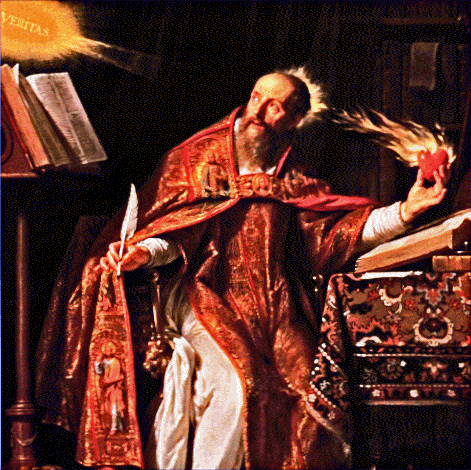
St. Augustine agrees that grace builds on nature- conversion never coerces will

So as I go forward and prepare for whatever is in store on this retreat, I am more aware than before how this is a foundation for the remainder of the year and that I must encounter God in "great silence" before I will be ready to go anywhere else with him. Union with God has been a recurring theme in prayer over the last few weeks, specifically the Sacred Heart of Jesus, and while there has been much consolation, the Memorial of St. Augustine today is a good reminder that I am seeking God, not the consolations of God.

Saturday, August 24, 2013

The Year in Review

It is hard to believe I am already starting my second year of formation with the Oblates! Time has flown by and it doesn't seem it will slow down any time soon. While having a memorable introduction to philosophy and my first apostolate assignment, I had a lot of time to adjust to the rhythm of life of Oblate formation, a rhythm that somehow remained fairly steady despite disaster, accident, and tragedy.

To complete the best year of my life I returned to Michigan for the Summer and spent a lot of time catching up with family and friends...  
                                                                                                  

and of course plenty of good beer. I was blessed to have a three-day trip back to Boston with my parents and am now gearing up for another year of surprises!

There are some ways in which this year will have fewer surprises- the daily life of formation will be more or less similar to last year- but there will be new classes and different classmates.

Because the shock of a major change and new lifestyle will be less, there is also great potential for this to be a year of great spiritual growth. Along this vein, I plan to focus my posts more on my life of formation than on remarkable events (there will still be some trips, but, please God, less terrorism).

I will hopefully be able to offer some insight into formation as a religious in general and a little of my own in particular, possibly starting with some excerpts and comments on Pastores Dabo Vobis (Bl. John Paul II's apostolic exhortation on priestly formation) and the Our Lady of Grace Handbook for postulant formation.

There may also be some tidbits from courses: Among other classes I will be taking Metaphysics, Documents of Vatican II, and History of Christian Spirituality, so I am certain there will be many interesting new things to share.

Today is the feast of St. Bartholomew, aka Nathaniel

It promises to be a remarkable year in many ways: in the near future I am looking forward to meeting Oblates from all over the Americas who will be here for a formation conference in a few weeks, celebrating the titular feast of the congregation, and Pope Francis' consecration of the world to the Immaculate Heart of Mary on 13 October.


Monday, April 22, 2013

The Boston Marathon Bombing: One Week Later

It has been a long week and, despite attempts to keep up with studying Latin and get papers written, it has nonetheless been remarkably unproductive time. Although Monday and (unexpectedly) Friday had no classes, all the excitement and tension made it rather difficult to concentrate (not to mention the noise!)


It has been one week since the Boston Marathon bombing, and although things have quieted down a over the weekend after the manhunt craziness, there is a reminder just down the street of all the victims affected. Fr. John Wykes, OMV made a short film of footage from the barricade. It is a simple but fitting tribute.

.

Tuesday, April 16, 2013

Divine Mercy and Providence

I expected to write a post with a much lighter tone today.

Yesterday was my first visit to the National Shrine of the Divine Mercy in Stockbridge, MA. As it turns out, Fr. Michael Gaitley, MIC went through formation with the OMV before he joined the Marians. He is currently the director of the Shrine and Marian Helper Center, as well as a well-known author. (In fact, he wrote his first book, Consoling the Heart of Jesus, while a seminarian at St. Clement's. It really makes one think about the use of one's time...).

One of our priests currently assigned in the Philippines is visiting Boston and wanted to go to the Shrine so I chose to tag along at the last minute (instead of going to watch at the Boston Marathon finish line as I had planned).

Fr. Michael cleared his schedule and spent the entire afternoon with us. We got a thorough update on new happenings with the Marians and a tour of their publishing center, which has recently been expanded to include a state-of-the-art gallery wrapping facility where reproductions of the Divine Mercy images are digitally impressed on canvas, stretched, and wrapped on wooden frames. It is part of the MIC expansion of their apostolate in distribution of Divine Mercy images.

In fact, many of the images that they (and others) have circulated for the passed half century have been revitalized by new digital copying and image editing technology in the last few years. One of these projects was the restoration of an original image from Lithuania started in the year 2000 and, more recently, continued work in digital enhancement to restore details lost through years of neglect.

Example of digital image restoration undertaken by the Marians.

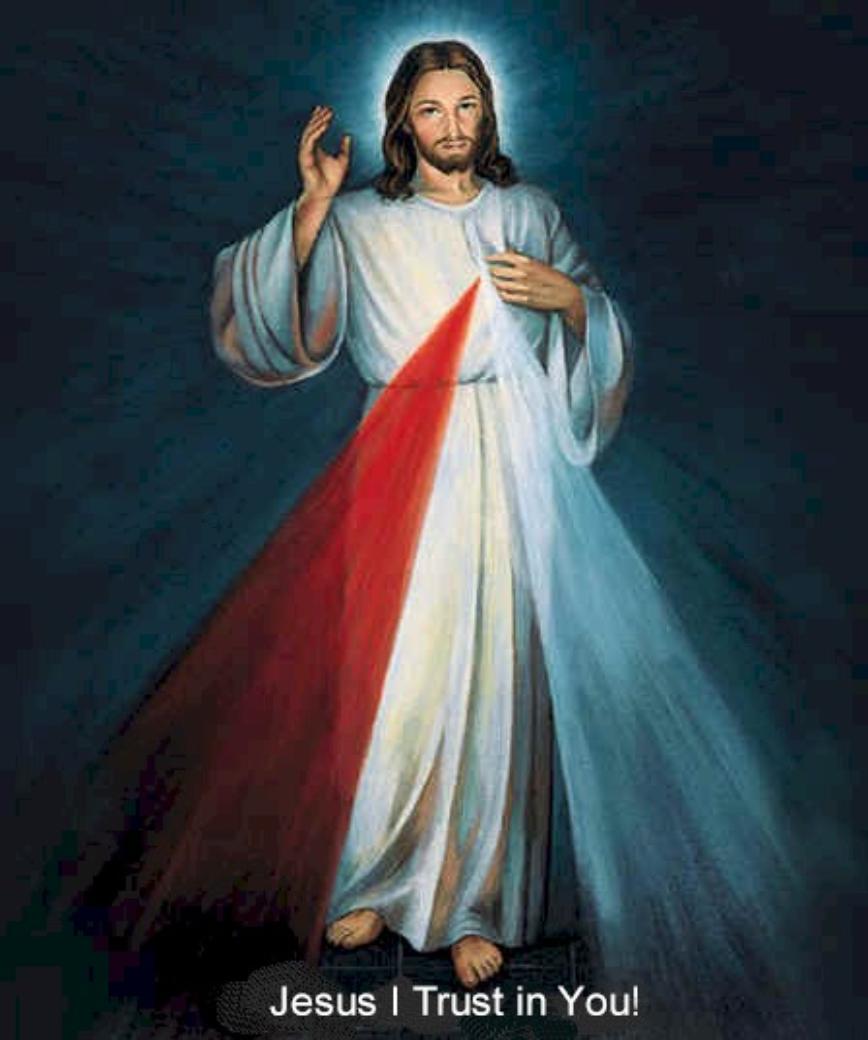
There are several popular versions of the Divine Mercy image (as revealed to St. Maria Faustina, that "Not in the beauty of the color, nor in the brush lies the greatness of this image, but in My grace."). But there is only one that St. Faustina herself directed the artist, known as the "Vilnius image" because of where it was painted. She reportedly wept after the artist's twelfth attempt to portray her description of her vision of Jesus, but realized it was grace and not the art that would change hearts. Despite this, the piece has several distinctive features that other popular images such as the Hyla (above) and Skemp versions do not. The Vilnius image is less well-known because Lithuania ended up part of the Soviet Union after the war and replicas were not easily obtainable. But it is regaining attention now that it is accessible and has had fifty-plus years of candle soot removed.    

Vilnius Image

Immediately after praying the chaplet at 3:00 was when we first heard about the bombings in Boston. Things were chaotic for a while as all the Oblates were being accounted for; Copley Square is only a few blocks from the shrine and even closer to St. Francis Chapel, and because it was a day off from class many of us had been about town by ourselves. Fortunately, four of us who had considered going down to the finish line were elsewhere for one reason or another.  


Over the next few hours, we debated whether to try and get back to Boston or stay over at the MIC monastery.  I was able to contact family members during the intervening time and let everyone know I was safe. It was difficult because the cell phone network had been suspended in Boston and other people we could communicate with outside the city didn't have complete information about security measures and road closures. We ended up returning but not getting back until late. We were only just able to get home by inbound Boylston Street: the evacuated area ended one block east of us.


Today was in some ways a regular Tuesday, but road blocks and national guardsmen in the neighborhood were a reminder that normality has not returned: a large segment of the city on our doorstep is still accessible only through security checkpoints.   

For me, it is very different to have something traumatic happen down the street. Hearing about terrorism in New York or D.C. was simply not as immanent as seeing the sidewalk I walk down several times a week pocked and blood-spattered. And knowing people who were in the area and recount taking cover or being evacuated through alleys before the dust had settled. And knowing that I had very nearly decided to be there myself. Even the tragedies of complete strangers are more evocative when I practically see the scene from the stoop. It feels very close to home.

The visit to the Shrine is salient not only because of the events of the day, but because of personal growth and my Lenten focus on God's Mercy: how I encounter it in my life and how I reflect it to others. It casts all the more relief on how small changes in the spiritual life loom large when the world seems shaken, such as how I react to those who need compassionate care and what I say to those struggling with anger or hatred or nursing wounded hearts, wounds only the grace of God can heal.   

Thank you to everyone who has been praying and offering support: it has been very comforting. I had an especially difficult time returning to my hospital apostolate this morning. Although I did not see any of the victims (but may when some begin rehab in a couple weeks), many of the patients had raw feelings surrounding their own accidents and injuries come up for discussion. Even though it was challenging, there were many opportunities for emotional healing and, by God's Mercy, small conversions of heart. So please keep praying!

Wednesday, March 13, 2013

Gaudium Magnum: Habemus Papam!

"Miserando atque Eligendo" ("In mercy and in choosing")- Cardinal Bergoglio's motto. Although it remains to be seen if Pope Francis will keep it, his humility is evident from not only his choice of motto, but from numerous personal attestations of how his has lived his religious vows: using public transportation, living in a simple apartment, doing his own cooking and housekeeping.

While there was some speculation earlier, apparently an official Vatican statement confirms that he chose his name in honor of Francis of Assisi, not Francis Xavier (directly). He is well known for his solidarity with the poor and has been an outspoken as a human rights advocate as well as on hot-button moral issues such as abortion and same-sex marriage.


Besides setting huge precedents by being a Jesuit from the Western Hemisphere and using an original papal name, it is also notable that His Holiness bowed in silence before the Urbi et Orbi blessing and asked all present to pray for him. After only witnessing one papal election, I did not realize at first what an enormous departure this was from protocol but several of the older priests watching the television with me were surprised as well as pleased when we were invited to join him in prayer. It speaks volumes that he is willing to shake things up as well as be humble and deferential. I eagerly await his installment and finding out what other surprises are coming!