Showing posts with label Saint Augustine of Hippo. Show all posts

Sunday, November 16, 2014

Saint Augustine of Hippo on the Second Coming

Well, we are in the last two weeks of Ordinary Time, something that the Office of Readings today brought home to me with a discourse by Saint Augustine that focuses on preparation for the second coming of Christ. 

Some of my reflection (full text below):

What is more true than that they should not themselves expect mercy from the judge, who themselves were unwilling to show mercy. What is imputed to those placed on his left side? That they refused to show mercy. 
The only criterion ever given by Jesus for particular judgment is whether mercy was freely given, and it should therefore be the most desirable of attributes. Mercy cannot be understood without justice: we know what we deserve and fear to suffer those consequences. Thinking of them as separate, I want to prefer one over the other, but in the Divine Essence these are not separate: God is entirely Mercy, God is completely Justice, and they are therefore inseparable. 

Let us hate our sins and love him who will exact punishment for them.
It is a strange idea that we should be grateful for punishment, that this ought to increase our love for God. But justice is an attribute of our Creator and something built into our nature: to love justice is essentially human, and by overcoming fear we come to desire it even for our own offenses. It is a gift that allows us to grow through our faults, a demonstration of God's desire that we overcome obstacles in order to increase and purify our love; he gives us the remedy of mercy by the treatment of justice.

If you wish to receive mercy, be merciful before he comes; forgive whatever has been done against you; give of your abundance. 
Here the Doctor makes it clear that he is referring to giving of material wealth, yet even those of us who lacking that have much to give in forgiveness. Everyone who receives God's forgiveness and mercy will receive it in abundance and therefore have much to give to others.


Second reading
From a discourse on the Psalms by Saint Augustine, bishop
Let us not resist the first coming, so that we may not dread the second

All the trees of the forest will exult before the face of the Lord, for he has come, he has come to judge the earth. He has come the first time, and he will come again. At his first coming, his own voice declared in the gospel: Hereafter you shall see the Son of Man coming upon the clouds. What does he mean by hereafter? Does he not mean that the Lord will come at a future time when all the nations of the earth will be striking their breasts in grief ? Previously he came through his preachers, and he filled the whole world. Let us not resist his first coming, so that we may not dread the second.

What then should the Christian do? He ought to use the world, not become its slave. And what does this mean? It means having, as though not having. So says the Apostle: My brethren, the appointed time is short: from now on let those who have wives live as though they had none; and those who mourn as though they were not mourning; and those who rejoice as though they were not rejoicing; and those who buy as though they had no goods; and those who deal with this world as though they had no dealings with it. For the form of this world is passing away. But I wish you to be without anxiety. He who is without anxiety waits without fear until his Lord comes. For what sort of love of Christ is it to fear his coming? Brothers, do we not have to blush for shame? We love him, yet we fear his coming. Are we really certain that we love him? Or do we love our sins more? Therefore let us hate our sins and love him who will exact punishment for them. He will come whether we wish it or not. Do not think that because he is not coming just now, he will not come at all. He will come, you know not when; and provided he finds you prepared, your ignorance of the time of his coming will not be held against you.

All the trees of the forest will exult. He has come the first time, and he will come again to judge the earth; he will find those rejoicing who believed in his first coming, for he has come.

He will judge the world with equity and the peoples in his truth. What are equity and truth? He will gather together with him for the judgment his chosen ones, but the others he will set apart; for he will place some on his right, others on his left. What is more equitable, what more true than that they should not themselves expect mercy from the judge, who themselves were unwilling to show mercy before the judge’s coming. Those, however, who were willing to show mercy will be judged with mercy. For it will be said to those placed on his right: Come, blessed of my Father, take possession of the kingdom which has been prepared for you from the beginning of the world. And he reckons to their account their works of mercy: For I was hungry and you gave me food to eat; I was thirsty and you gave me drink.

What is imputed to those placed on his left side? That they refused to show mercy. And where will they go? Depart into the everlasting fire. The hearing of this condemnation will cause much wailing. But what has another psalm said? The just man will be held in everlasting remembrance; he will not fear the evil report. What is the evil report? Depart into the everlasting fire, which was prepared for the devil and his angels. Whoever rejoices to hear the good report will not fear the bad. This is equity, this is truth.

Or do you, because you are unjust, expect the judge not to be just? Or because you are a liar, will the truthful one not be true? Rather, if you wish to receive mercy, be merciful before he comes; forgive whatever has been done against you; give of your abundance. Of whose possessions do you give, if not from his? If you were to give of your own, it would be largess; but since you give of his, it is restitution. For what do you have, that you have not received? These are the sacrifices most pleasing to God: mercy, humility, praise, peace, charity. Such as these, then, let us bring and, free from fear, we shall await the coming of the judge who will judge the world in equity and the peoples in his truth.

Wednesday, August 28, 2013

First Principle and Foundation

Man is created to praise, reverence, and serve God our Lord, and by this means to save his soul. All other things on earth are created for man that they may help him in accomplishing the end for which he is created. From this is follows that man is to use them as much as they help him to this end and ought to rid himself of them so far as they hinder him from it. For this it is necessary to make ourselves indifferent to all created things in all that is allowed to the choice of our free will and is not prohibited to it; so that on our part we do not prefer health to sickness, riches to poverty, honor to dishonor, long to short life, and so in all the rest; desiring and choosing only what is most conducive for us to the end for which we are created.

As I prepare for my silent retreat to inaugurate second year postulancy, I have returned to considering the First Principle and Foundation of St. Ignatius and reflecting on how my life has or has not been oriented to its ultimate end. Preparation for five days of silence may seem a bit superfluous, but I have come to appreciate how important it is to show up fully loaded for retreat.

I was sitting in for part of first pre-theology orientation at St. John Seminary, and the director of pre-theology emphasized the importance of conversion as part of formation: who you are and how you act outside of dedicated prayer depends entirely on what you are doing during that prayer. I have not only experienced this in my own formation, but have learned that practice and preparation have a large impact on prayer, which is itself how we pursue the end for which we are created. I am preparing for encounters with God in brothers, classmates, and ministry but will not be prepared for any of it without an inaugural colloquy to set the house in order. As one example, whenever I had attempted "finding God in everything" previously, I found it to be unfruitful because I was "without" when God was "within." Grace builds on nature; we must be disposed to God to hear him, and we must listen in silence before we can hear through noise.

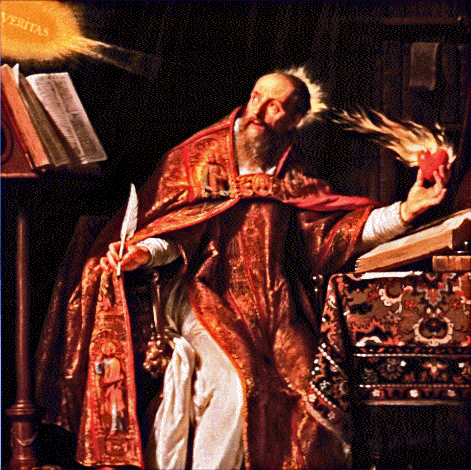
St. Augustine agrees that grace builds on nature- conversion never coerces will

So as I go forward and prepare for whatever is in store on this retreat, I am more aware than before how this is a foundation for the remainder of the year and that I must encounter God in "great silence" before I will be ready to go anywhere else with him. Union with God has been a recurring theme in prayer over the last few weeks, specifically the Sacred Heart of Jesus, and while there has been much consolation, the Memorial of St. Augustine today is a good reminder that I am seeking God, not the consolations of God.

Sunday, October 7, 2012

The Blogging Principle

What blogging principle do I mean, you may ask; the simple inverse relation that the more happens, the less time there is to write about it and the more compressed everything becomes in less frequent posts. This becomes manifestly evident as midterm examinations approach ominously and craziness continues as usual in Boston.

So, in today's news...

Today (observed yesterday) is the feast of Our Lady of the Rosary, commemorating the Battle of Lepanto in which the Turks were miraculously defeated. Hooray!

There are two new Doctors of the Church as of today: St. Hildegard of Bingen and St. John of Avila. Now that you know, you can look them up if you are interested in knowing more about them. St. Hildegard in particular is outstanding for many reasons, not the least of which is she is the only Saint to have her revelations declared to be of universal significance (as opposed to personal revelations) since the canon of Scripture was closed.

On the local front...

I promised a film review of Restless Heart, the new drama about the life and times of St. Augustine that I attended last weekend. (Spoiler alert: Augustine becomes a Christian).

The story is good; you can't go wrong with the lives of the Saints unless it is totally misinterpreted or altered, so no problem there. My criticism for the writing is that they tried to cover his entire life in 120 minutes and so many details were glossed over, particularly in his conversion. If you have read The Confessions, you know how richly he describes his experience, and I thought that would make an excellent film segment especially since the conflict he suffers is thoroughly modern and relatable to the post-modern and angst- ridden, but while there was a portrayal of his experience under the fig tree there was little/nothing of internal conflict portrayed. (I was later told that the original film was actually in Italian and more than 3 hours long by a classmate who saw it, so much was edited out from the English version for some reason).

As far as the acting, the principle parts were fairly good but there was something to be desired in the presentation overall; it struck me that they were doing more telling than showing conflict and drama.

As for everything else, I was confused by the use of CGI; there was a scene of migrating storks that was just distractingly fake, so I'm not sure why they could not have just found some stock footage of storks to solve that problem. Then, towards the end of the film, Hippo fell to a horde of 50-100 Vandals, so they really could have used some computer wizardry there to make the invasion a little more credible. The sound mixing also left something to be desired; the soundtrack was much too loud at some points to the extent of overpowering the dialogue.

Rating: 3/5 stars

The most exciting news is last: I had lunch with Jim Caviezel today! I guess he has been in Boston several times before and attended mass at St. Francis Chapel (which is staffed by the OMVs as you doubtless recall from previous posts). Today, he was visiting a friend in Boston who is a benefactor of the Oblates and attends Mass at the Shrine every Sunday. He was taking Jim to the Patriots game today and invited a couple of the Oblate priests to go, so they cam to Mass this morning and joined us for lunch in the refectory afterward. Jim was interested in all the seminarians and asked each of us for a brief account of our vocation story. We also got to hear from him about his life, his call to be an actor, personal and professional struggles, and anecdotes from filming The Passion, his other films, and Medjugorje.


Sunday, September 23, 2012

What Do Doozers Do?

Sorry for not posting last week, but it has been pretty busy. It seems there has yet to be a quiet, 'normal' week of postulancy; maybe there never will be!
Last week was the farewell dinner for our beloved Brother Luigi, who has been transferred to a quieter assignment after many years at St. Clement's. He has been an institution since the Oblates took over the shrine in 1976, so it really is the end of an era. I often met Br. Lou in the mornings while preparing breakfast and always enjoyed his wry humor, and I will miss him a lot. It was also the end of the conferences for which the Rector Major and many Oblates from overseas were visiting, so there were more farewell dinners and gatherings.

Today was the installation of Msgr. Moroney as the new Rector of St. John's Seminary, so we all went there for mass with Cardinal O'Malley which ended up being a lengthy affair because of pomp, family day at SJS, and excessive traffic due to bicycle races and a Red Sox game, but things will mostly return to normal this week.

However, I have yet to define what 'normal' is for a week of postulancy and talk about what it is I do all day anyway, so here is a week in my life now:


Monday-Friday
   5:30 am- Rise
   6:00 am- Morning holy hour, Office of
           Readings
   6:30 am- Lauds
   7:00 am- Mass
   7:30 am- Breakfast
   8:00 am-11:44 am- Daily responsibilities                      (class, study, apostolates, etc.)
   11:45 am- Eucharistic adoration, Divine Mercy
           Chaplet
   12:00 pm- Angelus, lunch
                                                                                       1:00 pm- 4:59 pm- Daily responsibilities
                                                                                       5:00 pm- Rosary, evening holy hour
                                                                                       5:45 pm- Vespers
                                                                                       6:00 pm- Dinner
                                                                                       7:00 pm- Community recreation (usually gym
                                                                                             time, sports, card games, etc.)         
                                                                                       8:00 pm (9:00 pm Fridays)- Study
                                                                                      10:00 pm- Compline and Great Silence


Saturday
   7:30 am- Lauds
   8:00 am- Breakfast
   9:00 am- Cleaning common areas
   11:00 am- Mass
   12:00 pm- 5:00 pm- Apostolate work in Boston
           or free time
   5:00 pm- Rosary, holy hour
   5:30 pm- Grand Vespers and Benediction
   6:00 pm- Dinner
   7:15 pm- Community recreation (movie night)
   11:00 pm- Great Silence

Sunday
   9:00 am- Matins, Lauds     
  10:00 am- Choir practice
  11:00 am- Mass
  12:15 pm- Lunch
  1:30 pm- Free time
  5:45 pm- Vespers
  10:00 pm- Great Silence 

In addition to the daily structure and classes, apostolates, etc., postulants have a number of other responsibilities assigned. All postulants are responsible for washing dishes and cleaning the kitchen after meals, and there is a weekly rotation for the following tasks: cantor for the Divine Office (also gets to choose the Saturday night movie), altar server for all masses, lector for masses and the Office, and cooking weekend dinners.

In addition to this are personal assignments that last all year, including an assignment for cleaning common areas of the seminary (I am the Dust Buster). Everyone is also responsible for doing their own laundry and keeping their cell neat (surprise inspections!). Postulants are also able to structure their own free time in the daily schedule between duties and studies for gym time, personal communication, personal prayer, and spiritual or recreational reading.

My personal assignment is to be one of the two sacristans: I am responsible for taking care of the sacred vessels (making sure they are purified, polishing, setting out the chalice and paten for whichever priest has the next Mass, etc.); purifying, laundering, and ironing purificators and corporals (and occasionally cassocks and surplices); measuring out wine, water, and altar bread for each Mass; making sure the correct propers are marked in the Sacramentary; checking that the correct vestment colors are used for feast days and solemnities; keeping four sanctuary lamps burning at all times; cleaning candle holders, incense thuribles, and tapers; doing any set up in the sanctuary, stripping the altar, moving candlesticks, etc.; and taking care of any other miscellanies around the sanctuary and sacristy.

My formation director who is also the choirmaster and usual piano accompanist for the Office, started having me playing piano for Grand Vespers on weekends.

So, if idleness was ever a vice it is no longer! Saturdays and Sundays are a little more flexible. Some of you have asked how available I am if you visit, and the answer it that it varies: I can be excused from community functions to spend time with out of town guests and can get other postulants to cover my responsibilities, so I can pretty much be free all weekend.  

There are also other outings and events interspersed in the weekly schedule; this is Boston, after all, and there is always plenty to do. Tonight we are all going to SJS for a special dinner and lecture on St. Augustine followed by a screening of the new biographical film Restless Heart at Boston College.

Tuesday, August 28, 2012

St. Augustine


I don't have much time for a post today, but I couldn't let the feasts of St. Monica (yesterday) and St. Augustine of Hippo (today) pass unmarked. In their honor, here are some excerpts from the Doctor's Confessions that have been significant for me in my spiritual growth:

"Belatedly I loved thee, O Beauty so ancient and so new, belatedly I loved thee. For see, thou wast within and I was without, and I sought thee out there. Unlovely, I rushed heedlessly among the lovely things thou hast made. Thou wast with me, but I was not with thee. These things kept me far from thee; even though they were not at all unless they were with thee. Thou didst call and cry aloud, and didst force open my deafness. Thou didst gleam and shine, and didst chase away my blindness. Thou didst breathe fragrant odors and I drew in my breath; and now I pant for thee. I tasted, and now I hunger and thirst. Thou didst touch me, and I burned for thy peace."

"Thou hast made us for thyself, O Lord, and our hearts are restless until they rest in thee."

"And men go abroad to admire the heights of mountains, the mighty waves of the sea, the broad tides of rivers, the compass of the ocean, and the circuits of the stars, yet pass over the mystery of themselves without a thought."

"No one knows what he himself is made of, except his own spirit within him, yet there is still some part of him which remains hidden even from his own spirit; but thou, O Lord, knowest everything about a human being because thou hast made him... Let me, then, confess what I know about myself, and confess too what I do not know, because what I know of myself I know only because thou hast shed light on me, and what I do not know I shall remain ignorant about until my darkness becomes like bright noon before thy face."