Showing posts with label Ignatian Prayer. Show all posts

Sunday, March 15, 2015

Let it Snow!

During our 30-day retreat, Boston received a record-breaking annual snowfall of over 110 inches. This was welcome to a couple of us who had wanted a snowy winter and a snowy retreat, but didn't expect it would all come in February. (The snow-haters had a lot to complain about, so they were secretly happy too).

Here are a few images that capture what we did between prayer periods on retreat:


Sunday, January 25, 2015

The Spiritual Exercises of Saint Ignatius of Loyola

Since I will be away for a while, I decided to leave a chunk of reading that will last for the entire month. Something of a skeletal summary of the 30-day Exercises, this may give you some idea of what I am engaged in over the next several weeks. What I wish to do is give a short outline of the Exercises for those who want to understand a little more about what I will be doing on retreat, but also to give personal annotations and how the various elements of the spirituality are present in my daily life.

At the very beginning of his Spiritual Exercises, St. Ignatius defines what he means by "spiritual exercises." Using the analogy of physical exercise, which includes everything done in order to improve physical conditioning, spiritual exercise is everything done in order to reach the highest possible state of spiritual conditioning. I have been learning over the past five months that spiritual exercise can be just as exhausting as physical exercise in its own way, so contrary to my vague impressions of yesteryear that the 30-day Exercises is something of an extended vacation to get in touch with one's spiritual faculties, it is far more closely analogous to boot camp.

The Spiritual Exercises are often judged to have an esoteric mystique, but Ignatian spirituality is really a way to understand everyday experience that is common to everyone. The "full" Exercises occurs in the context of the 30-day retreat, but is not confined to that; not only does it occur in a surprisingly diverse array of retreat formats, but the elements found in the Exercises are all applicable to daily life.

Some basic elements:

  • The retreat is silent: outside of meeting with a retreat director everyday for up to an hour, attending daily mass, and any other vocal prayer there is no other speaking, music, or other non-ambient sound. This serves multiple purposes, principally fostering a spirit of recollection and interior reflection, but also acknowledging that God speaks through all the events of daily life and not just times formally designated for prayer. 
*In daily life, the grand silence (9 pm to 6 am for us) serves the same purpose
  • The retreat is ideally conducted away from home and work: it is convenient for us that the Oblates have a retreat house very near, but it is good to be in an environment different from normal away from the distractions of daily life.
*This is not an essential element; St. Ignatius' 19th Annotation of the Exercises provides for those who are unable to take time away from their daily obligations for a 30-day or eight-day retreat, specifying that they should have 90 minutes set aside for silent prayer daily and meet with their director weekly. And, obviously, all elements of the Exercises used in daily life occur in the home/work environment. But being away really helps eliminate distractions.

  • The retreat consists of meditations on the Gospels or a designated theme four or five times daily during the retreat: this is the core activity of the Exercises. The person of Jesus is encountered in praying with the Scriptures, leading to deeper knowledge of him and self. 
*This is one of the core elements of formation throughout novitiate; it is part of the Spiritual Directory of the founder for all Oblates to meditate on the Gospel for at least one hour daily.
  • The retreat is about discernment: a major misconception about discernment equates it with decision making. The process of discernment is really about growth in relationship with God, which is another way of saying growth in knowledge of God and knowledge of self; decisions should be made out of this growth, but they are not the direct end in themselves. 
*This misconception probably stems from the fact that most people only make a really intense discernment (such as a 30-day retreat) when they are facing a really major life decision such as one relating to vocation or career, but it is still not correct to conceive of the retreat as being about the choice to be made- once again, choices made on or subsequent to retreat flow from encounter with God, the true goal of the Exercises.

The ultimate way that the Exercises and the Ignatian spirituality of discernment relate to choices is through freedom, which can be seen as the goal of the exercises. True freedom that comes from profound encounter with God and the self-knowledge that it imparts enables decisions to be made based on the experiences in life of how God is drawing one to himself, and to weed out superficial desires that can get all twisted up (but more on that later).


If you are still reading, congratulations! Your reward is further exposition on the structure and content of the Exercises.


The internal structure of the Exercises covers four phases, plus an introductory phase. (In the original text of the Exercises, these phases are referred to as 'weeks,' but contrary to another popular misconception, these do not correspond to chronological weeks but to different graces received in prayer; a person may make a 30-day retreat and remain in the first week the entire time).

A. The First Principle and Foundation (text here).
The Exercises begin (before they actually begin) with the personal experience of divine love. This is where the desire that drives discernment originates: if there is no sense of God creating me in love for a definite end, then there is nothing feeding my desire to know or serve him.

*This is the starting point of all Ignatian prayer; before the Examen, for example, one should "consider for a brief moment that God the Father is beholding me with love."

I. First Week
The goal of the first week is the conviction of personal sin and the experience of God's loving forgiveness, given at great cost to himself. It is not simply an exercise in rejecting one's specific personal sins, but seeking the grace to understand sin from a theocentric perspective, to experience God's own abhorrence of sin.
The most famous part of this week is the fifth exercise: application of the senses to the horrors of hell. It has sometimes been viewed as a way to force conversion by scaring exercitants, but Ignatius clearly specifies that it is not the starting point of the week but a final step of confirmation. The grace received is gratitude for realizing more fully what salvation means.

This is followed by the Kingdom Exercise, in which three questions are posed: What have I done for Christ? What am I doing for Christ? What must I do for Christ?
After the experience of the Foundation and First Week, this question invites one to a subtler, more nuanced way of loving. The Second Week does not begin automatically; Ignatius was clear that the director must see signs that the exercitant is seeking deeper intimacy and has the desire to grow in this more sensitive way of loving God.

II. Second Week
This is the school of discipleship. It is a deeper relationship with a desire to continue growing in knowledge of the other person. The Second Week of the Exercises employs a different set of rules for discernment than the First Week that reflect a more probing sensitivity in relating. This is where Ignatian contemplation, the entrance to intimate encounter through the application of the senses, a prayer that goes deeper than simple consideration, becomes the main component. Through repetitions, the person is affected on the deepest and most intimate dimensions. Ignatius knew that this is the only way that lasting transformation is effected.

The second phase is followed by the Two Standards Exercise, in which the exercitant considers that the only forces in the world are those acting with Christ or with the devil. ("standards" here refers to battle standards, not moral frameworks; the modern equivalent is sports, e.g. there are only two teams on a field). The grace is to examine the opposing mentalities- honor and pride vs. poverty and humility-, to penetrate the meanings of these words, and to realize the sometimes subtle differences between worldly ideas of success and how they can cause one to stray from the ultimate end.

III. Third Week
The focus of the third stage is the Paschal Mystery. It follows upon the first two phases as a deepening of the relationship by accompanying Jesus through his work of redemption. The Second Week begins with contemplating the Incarnation focused on the person of Jesus, but the subsequent contemplations are distinctly trinitarian even when focusing on the earthly life of Jesus.
The grace of the Third Week involves overcoming personal selfishness to a higher degree and identifying personal suffering more closely with Christ's Passion. Part of this is realizing the effect of personal sin, a connection back to the First Week and the "hard consolation" of learning the cost of love.

The following exercises are not fixed but can fall anywhere after the Second Week:
One is meditation on the Three Classes of Persons, a consideration of natural attachments and how they can prevent full commitment to God. Three types of people come into a large sum of money; the first feels attachment and, although desiring to make the right decision in regard to it, they never act on this desire and simply procrastinate. The second person feels attachment and, acting impulsively, preempts the will of God in the matter. He has an awareness of his inner dynamics, but although determined to do the "right thing," this is done without consultation to ascertain what God is asking. The third class of person will make a definitive decision, but without forcing it. He will take time for prayer and contemplation and not act until he has attained the freedom of embracing God's will, which might be in keeping the money as much as giving it away, not confusing the will of God with human intuition.

The other is the meditation on the Three Degrees of Humility and Love. This, like the previous exercise, is not something that is grounded in personality traits or temperament but is more of a test to see how far one has progressed in spiritual maturation; these degrees are a concrete illustration of love's process of becoming identified with whom is loved. In the first type, eternal salvation is so important that nothing can entice seriously to offense of the Beloved, love to the extent of never going against the Beloved's explicitly stated desire, something only possible after a deep experience of love. The second type builds on this and involves the sensitivity to detect the implicit, unstated desires of the Beloved and an eagerness to respond to those desires. This degree of love presumes the freedom of indifference to natural goods such as honor, wealth, health, longevity, etc. The third degree is a class of its own: the desire of imitation has been shed for the desire of unity, the desire for identification with the Beloved and the experience of joy when sharing poverty, contempt, and humiliation with Christ.

IV. Fourth Week
The last stage in the Exercises starts with the Resurrection and focuses on daily life, how life is affected by this deeper encounter with God and what things look like going forward. This is the stage of resolutions for daily life, but resolutions centered on being, not doing; this stage is about a new realization of who the exercitant feels called to be from this experience, a discernment of personal vocation distinct from discerning state in life.

The Contemplation to Attain Love is a rich revisitation of the previous stages of the exercises and the grace to be attained is complex, touching some or all of the previous experiences.

*It is important to note that, while the exercises are presented in a linear and consecutive manner for the formal Exercises, spirituality in daily life is never so neat. In a daily experience of prayer, one may experience some or all of the stages or 'weeks' of the Exercises in no particular order.

Sunday, January 18, 2015

Spiritual Thought: Sentire and Sapere

Novitiate is an experience that is difficult to describe, partly because much of it is deeply personal, but also because of its nature as raw experience, a direct communication through sense powers.

Saint Ignatius expressed this in the Spiritual Exercises by using the verb sentir rather than saber to express what is important in the spiritual life. (The words in Latin are sentire and sapere, which correspond to French sentir and savoir and Armenian kidenal and imanal).

The neat difference between the two verbs is something difficult to describe concisely in English, but roughly it is the difference between experiential knowledge and pure intellectual knowledge; sentir knowledge is felt and experienced through the senses, whether the external senses or the internal senses of imagination and memory. It is knowledge acquired through first-hand rather than second-hand experience, and can therefore be more difficult to communicate because it comes through wordless sensation rather than a verbal formula.

Saint Ignatius explains this in his Second Annotation to the Exercises, in which he instructs the retreat director to relate the points for meditation briefly in order to allow the exercitant more freedom for the experience that occurs in the meditation, 
For, if the person who is making the Contemplation takes the true groundwork of the narrative, and, discussing and considering for himself, finds something which makes the events a little clearer or brings them a little more home to him -- whether this comes through his own reasoning, or because his intellect is enlightened by the Divine power -- he will get more spiritual relish and fruit than if he who is giving the Exercises had much explained and amplified the meaning of the events. For it is not knowing much [saber], but realizing and relishing things interiorly [sentir], that contents and satisfies the soul.

-Spiritual Exercises, Second Annotation


His insight into prayer and how the human person experiences God through the senses relates what many consider arcane mysticism to the life of everyman. By the sixteenth century, Christian spirituality in the west threatened to split into scholastic intellectualism and spiritualist quietism, but his understanding of an integrated person calls for balance between sense experience and intellect within the mind.

This is why I contend that Ignatius has an Eastern Soul, one that transcends the dichotomy between mystical experience and intellectual definition and bridges the gap between the pietist and rationalist world views that later sprang up and have come to dominate modern thought. 

People versed in Catholic theology would be puzzled if Ignatius were referred to as a theologian; he studied but never taught nor wrote what are considered works of theology. But in the original sense used by the Cappadocian Doctors, a theologian is one who has a deep experience of God and shares it with others, in which sense the Spiritual Exercises is a profoundly theological work and Ignatius a theologian par excellence. 

Sunday, November 30, 2014

New Advent

Preparing for the season of Advent today, I came across a recommendation for approaching the daily readings. This is very helpful for me because I meditate on the readings every day, but even if you only focus on the Sunday readings it is still beneficial for entering into the readings more deeply.


The Two Parts of Advent 
(from Creighton University's Online Ministries)

Part 1: up until December 16
While most liturgical seasons have the gospel as their main focus, during the first weeks of Advent, the Church gives us daily readings from the prophet Isaiah.  With the eyes of faith, these foretell the coming of the Messiah. Rather than a continuous gospel narrative familiar to us for most of the year, this part of Advent offers a wide variety of gospel readings that support the first reading of the day. 

After almost two weeks of Isaiah readings, we hear the foretelling of a Messiah from other prophets from the Hebrew scriptures - in Sirach, Numbers, Zephaniah and returning to Isaiah. With each passing week, the prophets speak more clearly of the coming of a Savior. 

So, in reading the first reading, for the first part of Advent, we listen to the anticipation, expectation, hope and promise.  In listening to the second reading, we listen for the fulfillment or connection with the gospel.

Part 2: December 17 - 24

In these last eight days before Christmas, the relationship between the readings changes.  Now the gospel brings us to our celebration of Christmas.  The gospels are taken from the infancy narratives of Matthew and Luke. 

Each of these days, the first reading is taken from the Hebrew scriptures, and chosen to match the gospel.  In many cases we can imagine Matthew or Luke having the first reading open on their desks while they wrote the gospel.

So, we can read the gospel first and then read the first reading.  The sense of anticipation and fulfillment builds as we read the story of the preparation for Jesus' first coming into this world for us.

Sunday, November 9, 2014

Spiritual Thought: "Skandala"

After my daily meditation, there is often a thought that stays with me. Sometimes it is a clear message that came in prayer, sometimes it is a summary of what I experienced; a "spiritual thought" to take and carry through the day. Sometimes these are themes that surface repeatedly during a period of days, weeks, or months.

One of those recurring has been about skandala (obstacles) in the spiritual life. "My sins and faults are obstacles for me; they are not obstacles for God."

This is something worthwhile for meditation in moments of discouragement and failure; simply calling this to mind can allow me to access God's mercy and be reminded that humanity is an instrument not an obstacle for God.

Consider that temptations, faults, and sins are allowed by God as occasions of humility to remind me of my constant need for him and allow me to grow in my desire for him. This becomes an opportunity to enter into deeper prayer and be reminded that God is infinitely greater than my sins and limitations.

Saturday, September 28, 2013

Walden Pond

Today we had our day of recollection for September and instead of going to a retreat center or staying at the shrine, we went to spend a day in the woods and on the beaches at Walden Pond. The weather was great- ~70 degrees and mostly sunny- and the park was not too crowded before mid-afternoon, so it was the perfect time to be there and see the earliest autumn colors.  

Our meditation was on the prayer of Christ- his prayer, his teaching on prayer, his hearing our prayer, and how we join his prayer.

The most profound portion of my meditation was how Jesus receives and responds to every prayer of faith, whether aloud (Jairus, Bartholomaeus, the Canaanite woman, St. Dismas) or silent (the woman with the hemorrhage, the friends of the paralytic, the repentant prostitute).

I also recommend to anyone spending some time reflecting on a section about the prayer of Mary from CCC 2617 : "this is Christian prayer: to be wholly God's, because he is wholly ours" (cf. Song of Songs 2:16) and CCC 2618: Mary's intercession at the wedding in Cana "is the sign of another feast- that of the wedding of the Lamb where he gives his body and blood at the request of the Church, his Bride." Further explication about why the Magnificat of the Theotokos must also be our song gave me much to consider about growth in the virtue of humility.
I also read the full interview of Pope Francis recently released by Jesuit publications and really appreciated some of the insights into spiritual and apostolic life. Some of the Pope's personal insights really spoke to areas of growth in my life, particularly his points about magnanimity ("That means being able to do the little things of every day with a big heart open to God and to others"), discernment ("an instrument of struggle in order to know the Lord and follow him more closely"), and theodicy ("God has revealed himself as history, not as a compendium of abstract truths;" "God is always first and makes the first move"), among many other insights ("The vow of chastity must be a vow of fruitfulness;" "We must always consider the person... it is necessary to accompany them with mercy").  


 We passed through Concord and Lexington on our way back to Boston. Unfortunately we did not have time to stop and see the Minutemen Memorial or Lexington Common, but that might happen on another weekend some time this fall.


Wednesday, August 28, 2013

First Principle and Foundation

Man is created to praise, reverence, and serve God our Lord, and by this means to save his soul. All other things on earth are created for man that they may help him in accomplishing the end for which he is created. From this is follows that man is to use them as much as they help him to this end and ought to rid himself of them so far as they hinder him from it. For this it is necessary to make ourselves indifferent to all created things in all that is allowed to the choice of our free will and is not prohibited to it; so that on our part we do not prefer health to sickness, riches to poverty, honor to dishonor, long to short life, and so in all the rest; desiring and choosing only what is most conducive for us to the end for which we are created.

As I prepare for my silent retreat to inaugurate second year postulancy, I have returned to considering the First Principle and Foundation of St. Ignatius and reflecting on how my life has or has not been oriented to its ultimate end. Preparation for five days of silence may seem a bit superfluous, but I have come to appreciate how important it is to show up fully loaded for retreat.

I was sitting in for part of first pre-theology orientation at St. John Seminary, and the director of pre-theology emphasized the importance of conversion as part of formation: who you are and how you act outside of dedicated prayer depends entirely on what you are doing during that prayer. I have not only experienced this in my own formation, but have learned that practice and preparation have a large impact on prayer, which is itself how we pursue the end for which we are created. I am preparing for encounters with God in brothers, classmates, and ministry but will not be prepared for any of it without an inaugural colloquy to set the house in order. As one example, whenever I had attempted "finding God in everything" previously, I found it to be unfruitful because I was "without" when God was "within." Grace builds on nature; we must be disposed to God to hear him, and we must listen in silence before we can hear through noise.

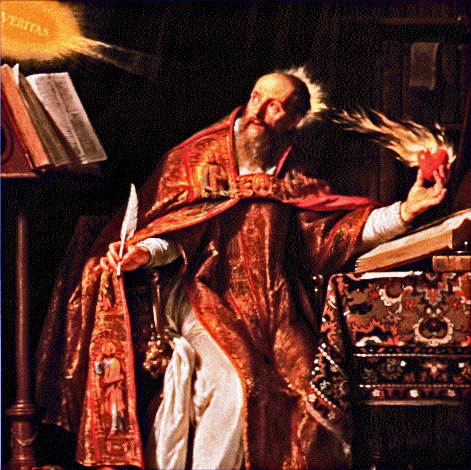
St. Augustine agrees that grace builds on nature- conversion never coerces will

So as I go forward and prepare for whatever is in store on this retreat, I am more aware than before how this is a foundation for the remainder of the year and that I must encounter God in "great silence" before I will be ready to go anywhere else with him. Union with God has been a recurring theme in prayer over the last few weeks, specifically the Sacred Heart of Jesus, and while there has been much consolation, the Memorial of St. Augustine today is a good reminder that I am seeking God, not the consolations of God.