Monday, March 14, 2016

Station III: Jesus Falls the First Time

Isaiah 40:30-31

Tissot, Jacques, 1836-1902. Jesus Falls Beneath the Cross.
Though young men faint and grow weary,
    and youths stagger and fall,
They that hope in the Lord will renew their strength,
    they will soar on eagles’ wings;
They will run and not grow weary,
    walk and not grow faint.

Psalm 143:1, 3

Lord, hear my prayer;
    in your faithfulness listen to my pleading;
    answer me in your righteousness.
The enemy has pursued my soul;
    he has crushed my life to the ground.
He has made me dwell in darkness
    like those long dead.

Matthew 7:13-14

“Enter through the narrow gate; for the gate is wide and the road broad that leads to destruction, and those who enter through it are many. How narrow the gate and constricted the road that leads to life. And those who find it are few."

Sunday, March 13, 2016

Station II: Jesus Bears his Cross

Isaiah 53:4-6

Yet it was our pain that he bore,
    our sufferings he endured.
We thought of him as stricken,
    struck down by God and afflicted,
But he was pierced for our sins,
    crushed for our iniquity.
He bore the punishment that makes us whole,
    by his wounds we were healed.
We had all gone astray like sheep,
    all following our own way;
But the Lord laid upon him
    the guilt of us all.

Psalm 40:2-4

Surely, I wait for the Lord;
    who bends down to me and hears my cry,
Draws me up from the pit of destruction,
    out of the muddy clay,
Sets my feet upon rock,
    steadies my steps,
And puts a new song in my mouth,
    a hymn to our God.
Many shall look on in fear
    and they shall trust in the Lord.

Mark 8:34-35

“Whoever wishes to come after me must deny himself, take up his cross, and follow me. For whoever wishes to save his life will lose it, but whoever loses his life for my sake and that of the gospel will save it."

Tissot, Jacques, 1836-1902. Jesus Bearing the Cross.

Saturday, March 12, 2016

Station I: Jesus is Condemned to Death

Wisdom 2:1a, 12, 14-15, 17-22

The wicked said among themselves,
    thinking not aright:
"Let us lie in wait for the righteous one, because he is obnoxious to us;
    he opposes our actions,
Reproaches us for transgressions of the law
    and charges us with violations of our training.
To us he is the censure of our thoughts;
    merely to see him is a hardship for us,
Because his life is not like that of others,
    and different are his ways.
Let us see whether his words be true;
    let us find out what will happen to him in the end.
For if the righteous one is the son of God, God will help him
    and deliver him from the hand of his foes.
Tissot, Jacques, 1836-1902. Ecce Homo.
With violence and torture let us put him to the test
    that we may have proof of his gentleness
    and try his patience.
Let us condemn him to a shameful death;
    for according to his own words, God will take care of him.”
These were their thoughts, but they erred;
    for their wickedness blinded them,
And they did not know the hidden counsels of God;
    neither did they count on a recompense for holiness

    nor discern the innocent souls’ reward.

Psalm 35:7, 11-12, 27-28

Without cause they set their snare for me;
    without cause they dug a pit for me.
Malicious witnesses rise up,
    accuse me of things I do not know.
They repay me evil for good;
    my soul is desolate.
But let those who favor my just cause
    shout for joy and be glad.
May they ever say, “Exalted be the Lord
    who delights in the peace of his loyal servant.”
Then my tongue shall recount your justice,
    declare your praise, all the day long.

John 3:14-15

"And just as Moses lifted up the serpent in the desert, so must the Son of Man be lifted up, so that everyone who believes in him may have eternal life."

Tuesday, March 1, 2016

Saint Peter Chrysologus on Mercy in Lent


The Office of Readings today has a gem from St. Peter Chrysologus that explains the spirit of lenten observances very lucidly.

If you hope for mercy, show mercy. If you look for kindness, show kindness. If you want to receive, give. If you ask for yourself what you deny to others, your asking is a mockery.

As Laetare Sunday approaches, I am glad to be reminded to be mindful and evaluate my lenten practices, especially in this jubilee year of mercy, and recall that forgiveness of injuries opens the wounded heart to receive forgiveness from God.


Second reading

From a sermon by Saint Peter Chrysologus, bishop
Prayer knocks, fasting obtains, mercy receives

There are three things, my brethren, by which faith stands firm, devotion remains constant, and virtue endures. They are prayer, fasting and mercy. Prayer knocks at the door, fasting obtains, mercy receives. Prayer, mercy and fasting: these three are one, and they give life to each other.

Fasting is the soul of prayer, mercy is the lifeblood of fasting. Let no one try to separate them; they cannot be separated. If you have only one of them or not all together, you have nothing. So if you pray, fast; if you fast, show mercy; if you want your petition to be heard, hear the petition of others. If you do not close your ear to others you open God’s ear to yourself.

When you fast, see the fasting of others. If you want God to know that you are hungry, know that another is hungry. If you hope for mercy, show mercy. If you look for kindness, show kindness. If you want to receive, give. If you ask for yourself what you deny to others, your asking is a mockery.

Let this be the pattern for all men when they practice mercy: show mercy to others in the same way, with the same generosity, with the same promptness, as you want others to show mercy to you.

Therefore, let prayer, mercy and fasting be one single plea to God on our behalf, one speech in our defense, a threefold united prayer in our favor.

Let us use fasting to make up for what we have lost by despising others. Let us offer our souls in sacrifice by means of fasting. There is nothing more pleasing that we can offer to God, as the psalmist said in prophecy: A sacrifice to God is a broken spirit; God does not despise a bruised and humbled heart.

Offer your soul to God, make him an oblation of your fasting, so that your soul may be a pure offering, a holy sacrifice, a living victim, remaining your own and at the same time made over to God. Whoever fails to give this to God will not be excused, for if you are to give him yourself you are never without the means of giving.

To make these acceptable, mercy must be added. Fasting bears no fruit unless it is watered by mercy. Fasting dries up when mercy dries up. Mercy is to fasting as rain is to the earth. However much you may cultivate your heart, clear the soil of your nature, root out vices, sow virtues, if you do not release the springs of mercy, your fasting will bear no fruit.

When you fast, if your mercy is thin your harvest will be thin; when you fast, what you pour out in mercy overflows into your barn. Therefore, do not lose by saving, but gather in by scattering. Give to the poor, and you give to yourself. You will not be allowed to keep what you have refused to give to others.

Sunday, February 7, 2016

Saint Gregory of Nyssa on Forgiveness

The forgiveness of debts is a unique and special prerogative of God.

It was said: “No one can forgive sins but God alone” (Mk 2:7).

A person obtains confidence in prayer by willingly imitating every conceivable attribute of God who is both kind and gentle, the source of all blessings and the dispenser of mercies to all.

It is not becoming that an evil person should enjoy intimacy with a good person, nor that a person who wallows in impure thoughts should have communion with one who is pure and undefiled.

In like manner, hardness of heart separates the supplicant from the love of God.

Whoever holds someone else in bitter bondage because of outstanding debts has by his own conduct excluded himself from divine love.

What communion can there be between love and cruelty, kindness and harshness, or any attribute and its opposite that is evil? Mutual opposition keeps them separated. For whoever is possessed by any particular attribute is necessarily estranged from its opposite.

Just as one who dies no longer lives, and the one who lives is estranged from death, so also he who approaches the love of God must necessarily be removed from every disposition of callousness.

Whoever is free of all those dispositions understood as being evil, he becomes in some way god by reason of his condition having achieved in himself what reason understands to be attributes of God.

Do you see to what greatness the Lord exalts those who hear Him through the words of the prayer? He transforms human nature in some way to be closer to the divine. He decrees that those who approach God should become gods.

Why do you come to God, He says, in a slavish manner, trembling in fear and plagued by your own conscience? Why do you exclude yourself from the confidence which coexists with the freedom of the soul from the beginning and which is intrinsic to the essence of your nature?

Why do you use flattery with Him who cannot be flattered? Why do you direct fawning and flattering words to the One who looks at deeds?

Every blessing that comes from God is permissible to you. You can possess it with a free spirit. Be your own judge. Cast the saving vote for yourself. Do you ask God to forgive your debts? Forgive the debts of others and God will cast his favorable ballot.

You yourself are the lord of judgment concerning your neighbor. This judgment, whatever it maybe, will bring an equal decision upon you. For whatever you decide to do, will be ratified by the divine judgment in your case, too.

Gregory of Nyssa (c 335 – c 394): Fifth homily on the Lord’s prayer.

Sunday, January 31, 2016

The Lectorate

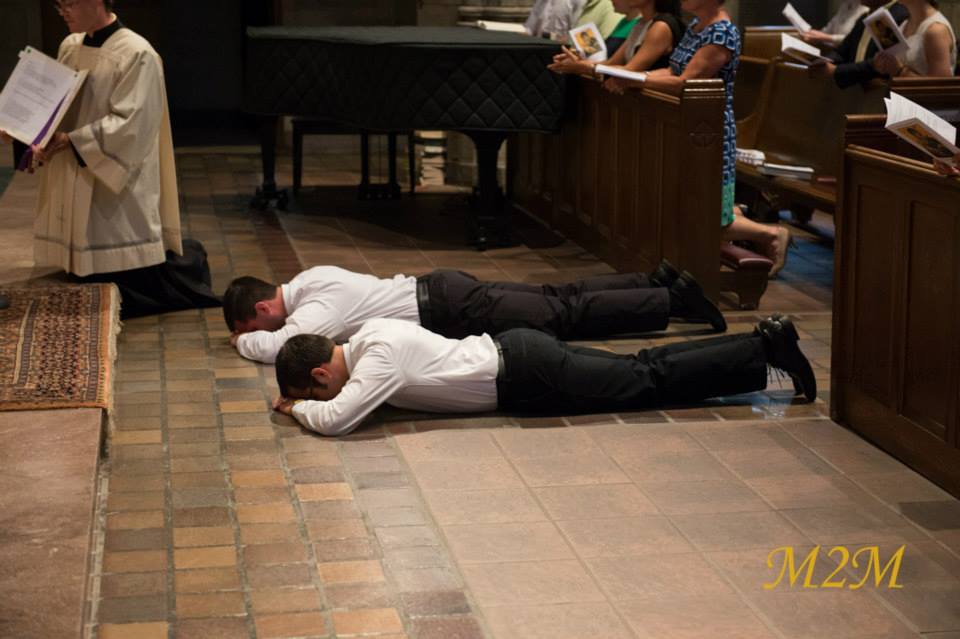
Earlier this month, four of us were instituted in ecclesial ministries at St. Clement's: two lectors and two acolytes.

The lector is appointed for a function proper to him, that of reading the word of God in the liturgical assembly. Accordingly, he is to proclaim the readings from sacred Scripture, except for the gospel in the Mass and other sacred celebrations; he is to recite the psalm between the readings when there is no psalmist; he is to present the intentions for the general intercessions in the absence of a deacon or cantor; he is to direct the singing and the participation by the faithful; he is to instruct the faithful for the worthy reception of the sacraments. He may also, insofar as may be necessary, take care of preparing other faithful who are appointed on a temporary basis to read the Scriptures in liturgical celebrations. That he may more fittingly and perfectly fulfill these functions, he is to meditate assiduously on sacred Scripture.
Aware of the office he has undertaken, the lector is to make every effort and employ suitable means to acquire that increasingly warm and living love and knowledge of Scripture that will make him a more perfect disciple of the Lord. 

Lector and acolyte in general correspond to the commissioned ministries of lector and extraordinary minister of holy communion, but with the important distinction that the former are permanent installations that apply in all times and places while the latter apply for the year of commission and only in the local parish. They are also more comprehensive: acolytes may expose and repose the Eucharist and prepare the altar at the offertory during Mass, and both lectors and acolytes are responsible for training other lay ministers (... preparing other faithful who are appointed on a temporary basis to read the Scriptures in liturgical celebrations).

In 1972, these ministries replaced the minor orders (exorcist, porter, lector, acolyte) and major order of subdiaconate, which along with the clerical tonsure were suppressed because they no longer reflected their original purposes. Although the ministries are required for candidates for Holy Orders and they are still reserved to men, Pope Paul VI specified that there is not an essential connection between them and the clerical state. This had previously been understood as beginning with the tonsure that signified entrance into priestly formation, but now it is ordination to the diaconate that signifies entrance to the clerical state.

Part of the rite of institution is being presented with the Bible, and I was allowed to select one for myself. I chose a bilingual Greek/English version of the Septuagint, the original translation of the Hebrew Bible into Greek from the second century B.C. This is the version of the Scriptures that was most widely used in the first century outside of Palestine and almost the exclusive source of the Old Testament quotes in the Gospels and Epistles. It shortly after fell out of favor with Jews, partly because the wording of prophecies supported the claim that Jesus is the Messiah and partly because most of the Greek-speaking Jewish populations were exterminated or dispersed by the Jewish-Roman wars of the second century, but it continued to be the authoritative version of the Old Testament for Christians until the Vulgate was promulgated in the early 4th century and replaced it in the west; it continues to be used by the Byzantine Churches and is the source of translations used by Syriac, Armenian, and Egyptian Christians.

The Septuagint differs from the Old Testament most familiar to the English-speaking world in a few ways. The most notable is the number of books, which is the reason for the difference between Protestant and Catholic Bibles; Protestant leaders eschewed the Septuagint because it was a translation and also because the books later excluded from the canon of the Hebrew Bible include some that are theologically problematic for Protestants; the books of Tobit, Judith, Wisdom, Sirach, 1 and 2 Maccabees, Baruch, and parts of Esther and Daniel only exist in the Greek version, which is why these were rejected by Jews and Protestants but have always been accepted by Orthodox Christians who use the older canon. Also, the numbering of the Psalms is different and the text of the Book of Jeremiah, among others, is significantly different.

Roman Catholic biblical scholars of the last few centuries followed the more prolific Protestant scholars and it became fashionable to hold the later Hebrew texts were more authentic and the Septuagint text was corrupted. This view has been significantly upset by the discovery of the Dead Sea Scrolls in 1947, which provide many Hebrew texts at variance with the Masoretic versions and generally confirm that most of the Septuagint comes from an older manuscript tradition. This has yet to gain widespread acceptance because biblical scholars in general continue to rely on the last three centuries of scholarship which is dominated by English and German Protestants, but it is one of the reasons why I am interested.

I don't have a picture of me being instituted, but here I am watching the acolyte institution.

Saturday, January 9, 2016

Saint Maximus of Turin on the Baptism of the Lord

From the Office of Readings

Second reading
From a sermon by Saint Maximus of Turin, bishop
The mystery of the Lord’s baptism

The Gospel tells us that the Lord went to the Jordan River to be baptized and that he wished to consecrate himself in the river by signs from heaven.

Reason demands that this feast of the Lord’s baptism, which I think could be called the feast of his birthday, should follow soon after the Lord’s birthday, during the same season, even though many years intervened between the two events. At Christmas he was born a man; today he is reborn sacramentally. Then he was born from the Virgin; today he is born in mystery. When he was born a man, his mother Mary held him close to her heart; when he is born in mystery, God the Father embraces him with his voice when he says: This is my beloved Son in whom I am well pleased: listen to him. The mother caresses the tender baby on her lap; the Father serves his Son by his loving testimony. The mother holds the child for the Magi to adore; the Father reveals that his Son is to be worshiped by all the nations.

That is why the Lord Jesus went to the river for baptism; that is why he wanted his holy body to be washed with Jordan’s water.

Someone might ask, “Why would a holy man desire baptism?” Listen to the answer: Christ is baptized, not to be made holy by the water, but to make the water holy, and by his cleansing to purify the waters which he touched. For the consecration of Christ involves a more significant consecration of the water.

For when the Savior is washed, all water for our baptism is made clean, purified at its source for the dispensing of baptismal grace to the people of future ages. Christ is the first to be baptized, then, so that Christians will follow after him with confidence.

I understand the mystery as this. The column of fire went before the sons of Israel through the Red Sea so they could follow on their brave journey; the column went first through the waters to prepare a path for those who followed. As the apostle Paul said, what was accomplished then was the mystery of baptism. Clearly it was baptism in a certain sense when the cloud was covering the people and bringing them through the water.

But Christ the Lord does all these things: in the column of fire he went through the sea before the sons of Israel; so now, in the column of his body, he goes through baptism before the Christian people. At the time of the Exodus the column provided light for the people who followed; now it gives light to the hearts of believers. Then it made a firm pathway through the waters; now it strengthens the footsteps of faith in the bath of baptism.

Saturday, September 19, 2015

Bishop Robert Baron on Punishment and Gift

I occasionally catch up on Bishop Robert Baron's Word on Fire videos, my nearest attempt to keeping up with popular culture. His commentaries generally start with a current event and connect it with other current events, philosophical thinkers, ecclesial teaching, etc., so I generally find them interesting.

This particular video was fascinating to me. It explores the connection of American comedian Stephen Colbert to J.R.R. Tolkien and John Henry Cardinal Newman.


The historical connection of providence is interesting, but in particular the Tolkien quote that prompted his reflection struck me.

 "Are not all of God's punishments also gifts?"

I noticed this partly because of my own experience and partly because of my Old Testament Narratives course, in which a major focus is the Babylonian Exile and post-exilic period in which the Jewish people had to reexamine their past and relationship to God in light of a traumatic experience.

From the very beginning of human experience when man sinned, God gave punishments not for despair but for hope. Work could be man's burden but also a source of his dignity; childbearing would be painful but also how God himself would enter the world in the most intimate way; the relationships of men and women would be plagued by misunderstanding and strife, but a constant reminder that their search for fulfillment is ultimately a search for God and not each other.

For surely I know the plans I have for you, says the Lord, plans for your welfare and not for harm, to give you a future with hope. Then when you call upon me and come and pray to me, I will hear you. When you search for me, you will find me if you seek me with all your heart.         Jeremiah 29:11-13


God has allowed trials and suffering in my life. Often I do not want to reflect on it and speak to God about my experience; often I just want to cry out for relief from pain. 

And how do I see my suffering? Is it a poison or a medicine? 

Jesus entered into the world of suffering and pain not as a teacher but as a priest and victim to make us an offering to God (cf. Friday vespers responsory). He sanctified suffering beyond what God decreed in the Protoevangelium (Genesis 3:15) so that it is no longer simply a spur to rouse us from complacency and reveal our need for God but actually a way to encounter him in our brokenness. 

Nowhere is this more explicit than the message of Divine Mercy. 
I have not come to call the righteous, but sinners (Luke 5:32).
The greater the sinner, the greater the right he has to My mercy (Divine Mercy in My Soul, 723).
My grace is sufficient for you, for power is made perfect in weakness (2 Corinthians 12:9).

The icon of this Mercy is Blood and Water flowing from the pierced side of Christ, the grace he pours out in Sacraments to fill suffering sinners beginning at the points of greatest brokenness and pain in our life. 

This means opening the wounds, allowing the dead tissue to be removed and the salve to be applied, which is scary! It demands deep trust, but there is only One who heals the broken hearted and binds up their wounds (Psalm 147:3). 


Saturday, September 12, 2015

St. Bernard on the Most Holy Name of Mary

Today is the titular feast of the Congregation of the Oblates of the Virgin Mary, the most important day of the year for us; our birthday celebration, if you will.
It is a day for celebrating our family, giving thanks to God for all the gifts he gives us, and renewing our dedication to serving the Congregation and the Church through the charism we have been given.

Most of the readings from the liturgies of the day recall the Annunciation, when our salvation begins when an archangel speaks the name of Mary, the pronouncement in which the salvation of each individual is bound (St. Louis de Montfort).

Her name bears immense power because of the unique bond between Mary and her Son. When God sent his Son born of a woman, he instituted a once and for all order of salvation in which the union of Mother and Child stands at the center (Romanus Cessario, OP).


Here is an excerpt from the Office of Readings for the day:

Second Reading: Mariam cogita, Mariam invoca, St. Bernard of Clairvaux, Abbot and Doctor

And the Virgin's name was Mary. Let us now say a few words about this name, which is said to mean "star of the sea," and is so becoming to the Virgin Mother... All of you, whoever you are, who feel that in the tidal wave of this world you are near to being tossed about among the storms and tempests than walking on the land, if you do not want to founder in the tempest, do not turn your eyes away from this shining star. When the wind of temptation blows up within you, when you strike upon the rock of tribulation, gaze up at this star, call out to Mary. If you are tossed by the waves of pride or ambition, slander or envy, look to the star, call upon Mary. If anger or greed or the desires of the flesh are battering the ship of your soul, gaze up at Mary. When the immensity of your sin weighs you down and you are ashamed of your guilty conscience, when the terrifying thought of judgment appalls you and you begin to sink into the gulf of sadness or the abyss of despair, think of Mary, call upon Mary. Let her name be even on your lips, ever in your heart. Follow the example of her life and you will obtain the favor of her prayer. Following her, you will not go astray. Invoking her, you will not despair. Thinking of her, you will not wander away. Upheld by her, you will not stumble. Protected by her, you will not fear. Guided by her, you will not tire. Favored by her, you will reach the goal. Then you will know by your own experience how true it is that "the Virgin's name was Mary."


Novice No More: First Profession of Vows

It has been quite a long time since my last update and much has transpired. I am no longer a novice! It was my intention to continue updates throughout the year, but novitiate becomes progressively more intense as the year develops and it becomes hard to divert energy as well as time to sharing the experience as it unfolds. In order to understand this, observe the following illustration that sums up the novitiate year:


On August 5th, novitiate ended and two of us made our first profession of vows in the religious life with the Oblates.


I am very grateful that my parents and siblings were all present. It was not easy for everyone to make it to the furthest tip of the country and I am thankful that they could come. I got to spend time with the family in Boston and during a two-week trip back to Michigan during August.


A new phase of my journey in religious life is underway! I am now under temporary vows and have begun studying for a masters degree in theology. As of the last week of August, the gang has returned from vacations and pastoral assignments and reassembled for the academic year. We have two new postulants and a total of ten men in formation for the St. Ignatius Province.