Tuesday, March 18, 2014

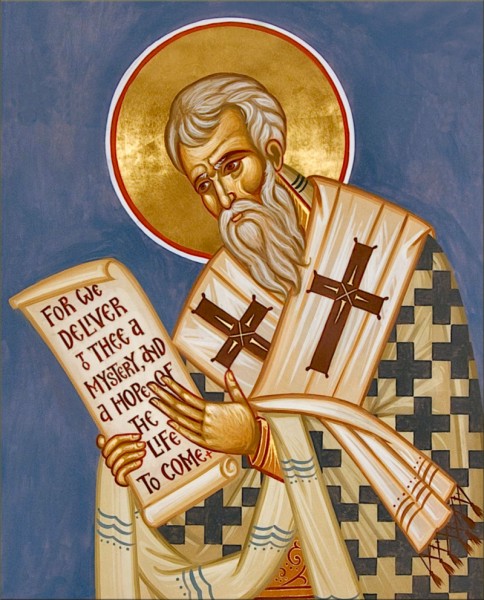
Saint Cyril of Jerusalem on New Creation

Disciples of the New Testament and partakers of the mysteries of Christ, as yet by calling only, but ere long by grace also, make you a new heart and a new spirit (Ezek. 18:31), that there may be gladness among the inhabitants of heaven.

For if over one sinner that repenteth there is joy, according to the Gospel (Luke 15:7), how much more shall the salvation of so many souls move the inhabitants of heaven to gladness.

As ye have entered upon a good and most glorious path, run with reverence the race of godliness.

For the Only-begotten Son of God is present here most ready to redeem you, saying, Come unto Me all that labour and are heavy laden, and I will give you rest (Matt. 11:28).

Ye that are clothed with the rough garment of your offenses, who are holden with the cords of your own sins, hear the voice of the Prophet saying, Wash you, make you clean, put away your iniquities from before Mine eyes (Isaiah 1:16):  that the choir of Angels may chant over you, Blessed are they whose iniquities are forgiven, and whose sins are covered (Ps. 32:1).

Ye who have just lighted the torches of faith, guard them carefully in your hands unquenched; that He, who erewhile on this all-holy Golgotha opened Paradise to the robber on account of his faith, may grant to you to sing the bridal song.

If any here is a slave of sin, let him promptly prepare himself through faith for the new birth into freedom and adoption; and having put off the miserable bondage of his sins, and taken on him the most blessed bondage of the Lord, so may he be counted worthy to inherit the kingdom of heaven.

Put off, by confession, the old man, which waxeth corrupt after the lusts of deceit, that ye may put on the new man, which is renewed according to knowledge of Him that created him (Eph. 4:22; Col. 3:10).

Get you the earnest of the Holy Spirit (2 Cor. 1:22) through faith, that ye may be able to be received into the everlasting habitations (Luke 16:9).

Come for the mystical Seal, that ye may be easily recognised by the Master; be ye numbered among the holy and spiritual flock of Christ, to be set apart on His right hand, and inherit the life prepared for you.

For they to whom the rough garment of their sins still clings are found on the left hand, because they came not to the grace of God which is given through Christ at the new birth of Bapti
sm:  new birth I mean not of bodies, but the spiritual new birth of the soul.

Cyril of Jerusalem (c. 313-386): Catechetical Lectures 1, 1-2.

Wednesday, March 12, 2014

Saint Symeon the New Theologian on Love

Let us be joyful in continuing the observance of Lent, because it is Christ who suffered for us that we approach in our weakness and brokenness; in approaching the redemptive action of Christ's passion, we embrace Love itself.

Love desired, how fortunate are those who have embraced you, for they will no longer have a yearning to embrace any human beauty.

How fortunate are they who are moved by divine love to cling to you: they’ll deny the whole world, and, to whatever degree they associate with others, they won’t be spoiled.

How fortunate are those who caress your beauty and delight in it with great desire, for their souls will be sanctified by the undefiled blood and water which issue from you.

How fortunate are those who passionately embrace you, for they will be altered for the better in spirit and will exult in their souls, because you are inexpressible joy.

How fortunate are they who gain possession of you, for they will count the treasures of the world as nothing, for you are indeed wealth “beyond the dreams of avarice”.

How blessed and thrice-blessed are they whom you accept, for though they be apparently without any glory, they will be more glorious than those who are glorious, more honoured than those who are honoured.

How worthy of praise are those who pursue you; even more so those who have found you.

Most blessed are those who are loved by you, received by you, taught by you, those who have dwelt in you and been fed by you with immortal food, that is the Lord, Jesus Christ.

Love divine, where are you holding Christ? Where are you concealing Him​? Why have you taken the Redeemer of the world and departed from us?

Open a wicket gate for us, so that we also may see Christ Who suffered for us, and so hope in His mercy that we’ll die no more when we once have seen Him. Open up to us, you who became the door allowing Him to be made manifest in the flesh.

Love, you who’ve forced the unforced and abundant compassion of our Master to bear the sins and infirmities of all people, do not reject us by saying, “I do not know you”. Be with us, so that you may come to know us, for we are not known to you.

Dwell in us, so that, for your sake, the Master may visit even us, who are lowly; go before us to meet Him, since we are wholly unworthy. So that He will pause on His way, to converse with you and will permit even us sinners to fall at His unblemished feet.

You’ll intercede on our behalf and plead with Him to forgive the debt of our sins, so that through you we may again be found worthy to serve Him, our Master, and be sustained and nourished by Him.

Symeon the New Theologian (949–1022 AD): In Praise of Those Who Have Love in Their Hearts

Saturday, March 8, 2014

Lenten Reflection: Grace in the Present Moment

"We never keep to the present. We recall the past; we anticipate the future as if we found it too slow in coming and were trying to hurry it up, or we recall the past as if to stay its too rapid flight. We are so unwise that we wander about in times that do not belong to us, and do not think of the only one that does; so vain that we dream of times that are not and blindly flee the only one that is."
-Blaise Pascal, Pensée 47

Lent is a time for mindfulness of the present. The physical sensations of hunger or other unfulfilled desires bring us back from the musings of the mind to the reality of existence here and now, reminding us that we depend on God for our being at every moment and that there is grace being offered in this moment for us to receive.

Let us not be content to merely consider what saints we could be with God's grace but strive to accept the grace as it is given.

Wednesday, March 5, 2014

Lenten Reflection: Returning to the Joy of the Gospel

During several discussions about spiritual practices for Lent, I have been a little disturbed about the prevalence of the misconception that we "give something up for Lent" as a way of either self-improvement or proving the possibility of surviving 40 days without chocolate or coffee.

Fasting has been (until recently) regarded as an integral part of the Christian spiritual life not because it is a way of proving something to God or simply identifying with the materially poor, but because it builds self-mastery in a way different from other disciplines. Long before the scholastic maxim "Grace builds on nature" had ever been quoted, the Desert Fathers understood that the self-mastery of the ascetic life opens us to God's grace in a way that is unique and profound.

If you have not yet decided on spiritual resolutions for this Lent, consider this: spiritual practices during Lent that are mortifying are not an end in themselves. Their purpose is not self-improvement, it is not torture, it is not merely identifying with the materially poor, but a return to God's grace.

Penance that reminds us of our sins and weaknesses should remind us of our need for God and awake in us a longing for closer union with him. Thus fasting and mortification should cause us joy, not grief - because everything we do in this season of grace recalls us to the joy of the Gospel.

As a further note on fasting and penance: these are regarded principally as outward signs of the inner disposition for conversion accompanied by spiritual practices; thus not keeping silence, showing charity, doing works of mercy, and intensifying prayer can vitiate a fast and make it an empty and joyless exercise of restraint.

Fast from food, feast on grace.
Fast from judgment, feast on mercy.
Fast from resentment, feast on forgiveness.
Fast from fear, feast on trust.
Fast from selfishness, feast on compassion.
Fast from idle gossip, feast on intentional silence.
Fast from anger, feast on patience.
Fast from complaints, feast on gratitude
Fast from darkness, feast on light.

Friday, February 14, 2014

Happy Valentine's Day

I bet you were expecting a post about St. Valentine... gotcha! 

SS. Cyril and Methodius may be two of the most important figures in the Christian history of Europe. Pope Bl. John Paul II did nothing without good reason, and that includes making them co-patrons of Europe (with St. Benedict of Nursia) at a time when the Gospel needs to be proclaimed again.

While the Apostles of the Slavs have a special place in the hearts of the Poles, Ukrainians, Slovaks, Czechs, Croats, etc., their legacy is of significance to all Christians. 

The second reading from the Office of Readings today:

From an Old Slavonic Life of Constantine

Build up your church and gather all into unity
Constantine, already burdened by many hardships, became ill. At one point during his extended illness, he experienced a vision of God and began to sing this verse: “My spirit rejoiced and my heart exulted because they told me we shall go into the house of the Lord.”
  Afterward he remained dressed in the vestments that were to be venerated later, and rejoiced for an entire day, saying: “From now on, I am not the servant of the emperor or of any man on earth, but of almighty God alone. Before, I was dead, now I am alive and I shall live for ever. Amen.”
  The following day, he assumed the monastic habit and took the religious name Cyril. He lived the life of a monk for fifty days.
  When the time came for him to set out from this world to the peace of his heavenly homeland, he prayed to God with his hands outstretched and his eyes filled with tears: “O Lord, my God, you have created the choirs of angels and spiritual powers; you have stretched forth the heavens and established the earth, creating all that exists from nothing. You hear those who obey your will and keep your commands in holy fear. Hear my prayer and protect your faithful people, for you have established me as their unsuitable and unworthy servant.
  “Keep them free from harm and the worldly cunning of those who blaspheme you. Build up your Church and gather all into unity. Make your people known for the unity and profession of their faith. Inspire the hearts of your people with your word and your teaching. You called us to preach the Gospel of your Christ and to encourage them to lives and works pleasing to you.
  “I now return to you, your people, your gift to me. Direct them with your powerful right hand, and protect them under the shadow of your wings. May all praise and glorify your name, the Father, Son and Holy Spirit. Amen.”
  Once he had exchanged the gift of peace with everyone, he said: “Blessed be God, who did not hand us over to our invisible enemy, but freed us from his snare and delivered us from perdition.” He then fell asleep in the Lord at the age of forty-two.
  The Patriarch commanded all those in Rome, both the Greeks and Romans, to gather for his funeral. They were to chant over him together and carry candles; they were to celebrate his funeral as if he had been a pope. This they did.

Prayer:
Saint Cyril and Saint Methodius were your instruments, Lord,
  in bringing the light of the gospel to the Slavonic peoples.
May we take your word into our hearts
  and be at one in professing the true faith.
Through our Lord Jesus Christ, your Son,
  who lives and reigns with you and the Holy Spirit,
  one God, for ever and ever.

Saturday, February 8, 2014

Saint Anthony the Great on Mind and Spirit

These things I have said to you, beloved, that you may know how it is required of a man to repent in body and soul, and to purify them both.

And if the mind conquers in this contest, then it prays in the Spirit, and begins to expel from the body the passions of the soul which come to it from its own will. Then the Spirit has a loving partnership with the mind, because the mind keeps the commandments which the Spirit has delivered to it.

And the Spirit teaches the mind how to heal all the wounds of the soul, and to rid itself of every one, those which are mingled in the members of the body, and other passions which are altogether outside the body, being mingled in the will.

And for the eyes it sets a rule, that they may see rightly and purely, and that in them there may be no guile. After that is sets a rule also for the ears, how they may hear in peace, and no more thirst or desire to hear ill speaking, nor about the falls and humiliations of men; but how they may rejoice to hear about good things, and about the way every man stands firm and about the mercy shown to the whole creation, which in these members once was sick. 

Then again the Spirit teaches the tongue its own purity, since the tongue was sick with a great sickness. For the sickness which afflicted the soul was expressed in speech through the tongue, which the soul used as its organ, and in this way a great sickness and wound was inflicted upon it, and especially through this member – the tongue – was the soul stricken.

The Apostle James testifies to us and says, “If any man thinketh himself to be religious and bridleth not his tongue, but deceiveth his own heart, this man’s religion is vain” (Jas. 1:26), And in another place he says, “The tongue is a little member, and defileth the whole body” (Jas. 3:5) – and much besides, which I cannot all quote now.

But if the mind is strengthened with the strength that it receives from the Spirit, first it is purified and sanctified, and learns discrimination in the words that it delivers to the tongue, that they may be without partiality and without self-will.

And so the saying of Solomon is fulfilled, “My words are spoken from God, there is nothing froward nor perverse in them” (Prov. 8:8). And in another place he says, “The tongue of the wise is healing” (Prov. 12:18); and much besides.


Anthony the Great (c.251-356): Letter 1.

Thursday, February 6, 2014

Saint Anastasius of Sinai on the Church

Do you not know that the Church of God is a surgery and a harbor?

Now, if you remain in a surgery ailing and unhealed, when, henceforth, will you be cured? And if you are tempest-tossed in a harbor, where, hereafter, will you find rest?

Stand with reverence, I implore you. Stand with awe at the fearful hour of the Anaphora; for with whatever attitude and thoughts each of you attends at that hour, such also is the frame of mind in which he offers worship to the Master.

The oblation is called the Anaphora because it is offered up to God. Therefore, stand before God in silence and compunction. Confess your sins to God through the priests. Condemn your actions and do not be ashamed; for, there is a shame that brings sin, and there is a shame which is glory and grace (Ecclesiasticus 4:21). Condemn yourself before men, so that the Judge may justify you before angels and the whole world.

Seek mercy, seek forgiveness, seek remission of past sins and deliverance from future sins, so that you may approach the Mysteries worthily, so that you may partake of the Body and Blood with a pure conscience, and so that it may be for your purification and not for your condemnation.

Hear what the Divine Paul says: Let each man examine himself, and so let him eat of that Bread, and drink of that Cup. For he that eats and drinks unworthily, eats and drinks damnation unto himself, not discerning the Lord's Body. For this cause many are weak and sickly among you, and many sleep (1 Corinthians 11:27-30).

[...] you will become worthy, if only you desire it. Recognize that you are a sinner. Cut yourself off from sin. Desist from sin, wickedness, and anger. Display the works of repentance; endue yourself with prudence, meekness, and forbearance. Show compassion from the fruits of righteousness for those in need, and you will have become worthy. Beseech God with a contrite heart, and He will fulfill your petitions; for, if you do not do this, you will be wasting the time you spend in church.

[...] I beseech you to pray as you ought, so that when we draw near to God in our prayers, we may stand before Him in a way that befits Him.

Anastasius of Sinai (7th Century): A Homily on the Holy Eucharist and on Not Judging Others or Remembering Wrongs, PG 89, 825A-849C

Friday, October 25, 2013

Saint Bernard of Clairvaux on Sin

I have had the intention of writing several posts for the whole month of October but have been caught up in the business of life and not done anything beyond think about it. However, I have found several things of interest worth sharing and I have at least enough time to share one of them now.                                                                                             St. Bernard of Clairvaux, Doctor Mellifluis, is one of my favorite sources for spiritual reading and while the writings I usually select are mariological, today I used one of his sermons on sin for meditation.
Sermon 63.6b on the Song of Songs, The Fox in the Vineyard (my formatting)

If this cold once penetrates the soul when (as so often happens)
the soul is neglectful and the spirit asleep and if no one (God forbid) is there to curb it,
then it reaches into the soul’s interior,
descends to the depths of the heart and the recesses of the mind,
paralyzes the affections,
obstructs the paths of counsel,
unsteadies the light of judgment,
fetters the liberty of the spirit,
and soon – as appears to bodies sick with fever – a rigor of the mind takes over:
vigor slackens,
energies grow languid,
repugnance for austerity increases,
fear of poverty disquiets,
the soul shrivels,
grace is withdrawn,
time means boredom,
reason is lulled to sleep,
the spirit is quenched,
the fresh fervor wanes away,
a fastidious lukewarmness weighs down,
brotherly love grows cold,
pleasure attracts,
security is a trap,
old habits return. Can I say more?
The law is cheated,
justice is rejected,
what is right is outlawed,
the fear of the Lord is abandoned.
Shamelessness finally gets free rein.
There comes that rash leap, so dishonorable, so disgraceful, so full of ignominy and confusion;
a leap from the heights into the abyss,
from the court-yard to the dung-heap,
from the throne to the sewer,
from heaven to the mud,
from the cloister to the world,
from paradise to hell.

Saturday, September 28, 2013

Walden Pond

Today we had our day of recollection for September and instead of going to a retreat center or staying at the shrine, we went to spend a day in the woods and on the beaches at Walden Pond. The weather was great- ~70 degrees and mostly sunny- and the park was not too crowded before mid-afternoon, so it was the perfect time to be there and see the earliest autumn colors.  

Our meditation was on the prayer of Christ- his prayer, his teaching on prayer, his hearing our prayer, and how we join his prayer.

The most profound portion of my meditation was how Jesus receives and responds to every prayer of faith, whether aloud (Jairus, Bartholomaeus, the Canaanite woman, St. Dismas) or silent (the woman with the hemorrhage, the friends of the paralytic, the repentant prostitute).

I also recommend to anyone spending some time reflecting on a section about the prayer of Mary from CCC 2617 : "this is Christian prayer: to be wholly God's, because he is wholly ours" (cf. Song of Songs 2:16) and CCC 2618: Mary's intercession at the wedding in Cana "is the sign of another feast- that of the wedding of the Lamb where he gives his body and blood at the request of the Church, his Bride." Further explication about why the Magnificat of the Theotokos must also be our song gave me much to consider about growth in the virtue of humility.
I also read the full interview of Pope Francis recently released by Jesuit publications and really appreciated some of the insights into spiritual and apostolic life. Some of the Pope's personal insights really spoke to areas of growth in my life, particularly his points about magnanimity ("That means being able to do the little things of every day with a big heart open to God and to others"), discernment ("an instrument of struggle in order to know the Lord and follow him more closely"), and theodicy ("God has revealed himself as history, not as a compendium of abstract truths;" "God is always first and makes the first move"), among many other insights ("The vow of chastity must be a vow of fruitfulness;" "We must always consider the person... it is necessary to accompany them with mercy").  


 We passed through Concord and Lexington on our way back to Boston. Unfortunately we did not have time to stop and see the Minutemen Memorial or Lexington Common, but that might happen on another weekend some time this fall.


Wednesday, September 18, 2013

Contemplatives and Missionaries


"Be contemplatives and missionaries"- one of Pope Francis' exhortations in his address to seminarians and novices in July, in which he urged the men in formation to 'pastoral fruitfulness' and to avoid the trap of sterility that comes from not embracing pastoral paternity. "Go out of yourselves to proclaim the Gospel, but to do this you must go out of yourselves to encounter Jesus."

He began his talk focusing on joy as essential in the spiritual life: "wherever there are consecrated persons... it's the joy of following Jesus; the joy that the Holy Spirit gives us, not the world's joy." 
But this joy is not "the inebriation of a moment" that comes from possessions, power, or admiration; true joy "is born from the encounter, from the relation with others... from the gratuitousness of an encounter... to feel loved by God, to feel that to him we are not numbers, but persons; and to feel that it is he who calls us." 

"There is no holiness in sadness." (cf. St. Teresa of Avila)

Addressing the cause of lack of joy, he focused on celibacy that is lived badly."The root of sadness in pastoral life lies in the lack of paternity that comes from living the consecration badly." 
"The vow of chastity does not end at the moment of the vow... it's a journey that matures... [and] when a priest is not the father of his community... they become sad." A consecrated life lived well should be fruitful and joyful from sharing the life found in Jesus.

He called us to build good communities that foster fraternal love by avoiding gossip, often "the most common short prayer.. but such a community is a hell! Behind gossip... are envies, jealousies, ambitions. Not to speak badly of others; this is a beautiful path to holiness!"

Authenticity was another theme: he urged formators to be exampled of coherence to young people, especially in poverty, and challenged us to be more transparent with confessors, always. 
"This transparency will do you good, because it makes one humble... tell the truth, without concealment or dissimulation" and to be faithful to one confessor and not go on "a pilgrimage to confessors to conceal truth." 

"Open the door to grace with this transparency!"

He also reminded us of the importance of daily examination recommended by saints and spiritual masters as indispensable to the spiritual life. I can attest to this from my own life- I have found there is a tremendous difference in my spiritual life when neglecting the Examen even one day. It is the loss of a unique encounter. Just as one would not go home and skip a rapprochement with a spouse or parent after a difficult work day, this encounter with God is central to the life of prayer.